Please enter a minimum of 2 characters to search.
Please enter a minimum of 2 characters to search.

Memorial Keepers(2)
They manage this memorial. Contact or join


John Alfred Chambers
January 14th, 1949 - July 13th, 2026
January 14th, 1949 - July 13th, 2026
“Happy to be alive!”
That was how John Chambers answered whenever anyone asked how he was doing. It was not merely a pleasant greeting; he meant the words.
John, known as “JC” to generations of students, colleagues, friends, and family, died on July 13, 2026 at the age of 77. Across a long career in public education and a rich life full of family, friendship, sailing, poetry, and service, he had a gift for making people feel seen. He believed in their possibilities, sometimes before they could see those possibilities for themselves.
He also believed that he had been given not one life, but two.
In his thirties, while serving as principal of John Jay High School in Cross River, New York, John was diagnosed with non-Hodgkin lymphoma. He endured years of aggressive treatment, several close calls, and a then-experimental bone marrow transplant. His family, friends, and the John Jay community rallied around him, and he emerged with a profound appreciation for the extra time he had been given. Years later, to his classmates at his beloved Williams College, he would describe himself as “permanently intoxicated with life.”
Near the end of that life, when told by his children that he had lived a good life, John corrected them immediately: “Two!”
He lived more of his years in remission than he had before cancer, and he touched more lives, more deeply, as a result. His gratitude was not passive; it animated him. You could hear it in his laughter, feel it in his curiosity, and see it in the attention he paid to others. Anyone who ever heard him answer “Happy to be alive!” knew that it was true.
Born on January 14, 1949, in Ballston Spa, New York, to Ruth and Marvin Chambers, John grew up with his brothers, Grant and James, and his sister, Eve, in a home filled with love, expectation, and a strong sense of purpose.
Ruth was a force of nature. On a door in the kitchen of the family home on Brookline Road, she had painted the following verse:
“Most of us creep into life
Not knowing why we are here
Save for to consume the corn, the flesh, the fish
And leave behind an empty dish
What are YOU here for?"
The question stayed with John. And in many ways, the life he built became his answer.
John attended Williams College, graduating in 1971. The education, experiences, and relationships he formed there were the foundation of the rest of his life. As he was preparing to leave, his mentor, the historian Fred Rudolph, suggested that he might make a gifted educator. Rudolph told him that, should he decide to pursue that path, there was a scholarship waiting for him to earn a master’s degree in education at Harvard.
John took him up on it.
He began his career teaching history before moving into school administration. He served as an assistant principal at Scarsdale High School and, in the early 1980s, became principal of John Jay High School. It was there that students began calling him “JC,” a name that followed him for the rest of his life and eventually became as natural within his family as it was in the halls of John Jay.
John later served as superintendent of the Bronxville and Byram Hills school districts. Even after stepping away from full-time leadership, retirement took several attempts. He continued serving as an interim superintendent and taught at Bank Street College of Education, where he mentored future principals, deans, superintendents, and other educational leaders.
Through every title and every stage of his career, John carried with him the perspective of the classroom teacher he had been. He did not see his teaching experience as a rung on a ladder he had climbed past; it formed the foundation of his leadership philosophy.
He was a passionate believer in public education, not only as an institution but as a democratic promise. John believed education was a basic human right and one of society’s greatest instruments of possibility. He loved Horace Mann’s injunction, “Be ashamed to die until you have won some victory for humanity.”
John did not measure those victories by prestige, credentials, or the names of the colleges his students attended (unless that name was Williams). He saw the whole person. The former students he remembered most fondly were not necessarily the valedictorians or the conventionally accomplished; they were the young people whose potential might have been easier to miss. He was interested not in whether a life followed the expected path, but in whether a person found purpose, dignity, and a way to contribute.
That instinct extended beyond his work in education. John sought genuine connection with nearly everyone he met. He could command a room, but never needed to dominate one. Tall, handsome, impossibly intelligent, warm, funny, curious, and a little mischievous, he was both a gifted storyteller and a thoughtful listener.
His friendships ignored rank and résumé. He moved as easily among people who worked with their hands as among those who had won a Pulitzer Prize, meeting each with equal respect and curiosity. What impressed him most was character, wit, generosity, or a good story.
John’s life outside work was every bit as full as his professional one.
He was a lifelong and fiercely loyal Boston Red Sox fan. He loved poetry, carried an extraordinary number of poems within him and delighted in reciting them. He hosted an annual Burns Supper, raised a wee dram of Scotch with friends, and understood that poetry was not something to be admired on the page; it was meant to be spoken aloud, shared at table, and called upon when ordinary language was insufficient. Even in the last days of his life, when speaking a single word required enormous effort, he summoned Yeats’ “The Song of Wandering Aengus” in full, entirely from memory.
John was also politically engaged and proudly progressive. He cared deeply about the environment, equality, civic life, and the responsibilities people owe to one another. He lived by the maxim “Think globally, act locally.” In his later years, he joined other former school superintendents in advocating against gun violence. His politics grew from the same conviction that shaped his work in schools: that every young person deserves the chance to grow up safely and discover what they might become.
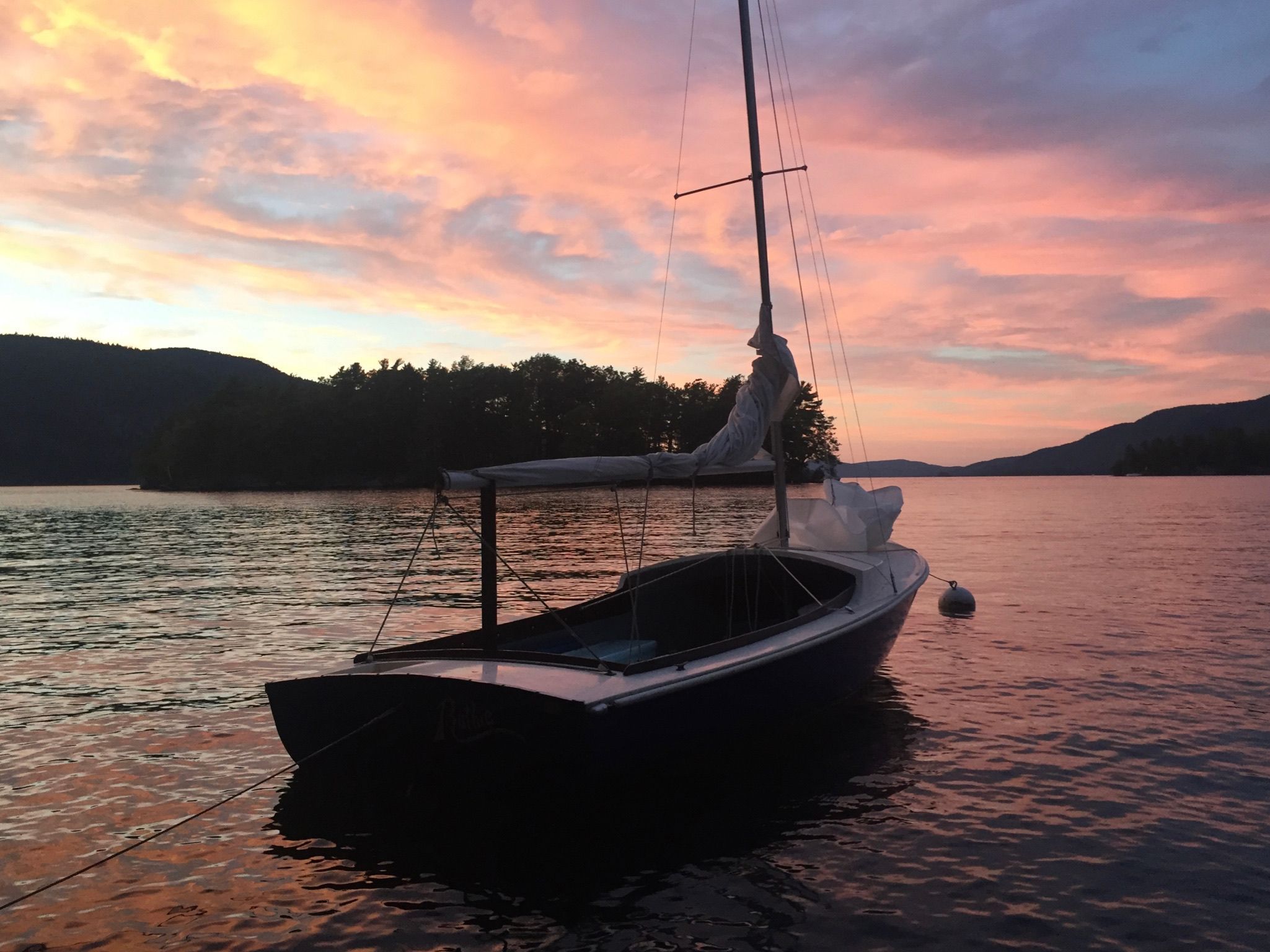
Few things brought JC more joy than sailing. He learned the art on Lake George from his father-in-law, who would holler, “This is really livin’!” whenever the wind came up. John loved the line so much that, years later, he named his sailboat Really Livin’ in tribute to the man who had taught him. What began in small dinghies and day sailors grew into a lifelong passion. He sailed aboard schooners, ketches, and sloops, and led several educational voyages for students and teachers in the U.S. Virgin Islands. He loved the water, the wind, the art of sailing, and the fellowship that formed aboard boats of any size. He even loved the knots and delighted in demonstrating how to tie a flying bowline.
Lake George held a central place in John’s life long before he made his home there. As a boy, he camped with his family at Rogers Rock. In the 1990s, he scraped together enough money to purchase a historic house in Huletts Landing, on the Eastern shore of the lake he loved, and over time, that property has become one of the great works of his life.
It became a gathering place for his children Melissa and Jesse, their families, and a wide and ever-expanding circle of friends. Summers there were filled with swimming, boats, family dinners, conversations, endless projects, laughter, and memories layered one upon another. John later designed and built a small house on the property, adding another physical chapter to a place that had become a magnet for the family and friends he loved.
Huletts Landing was not a nostalgic escape from life; it was a place where more life could happen.
Williams held a similarly enduring place in John's life. His loyalty to the college and to the Class of 1971 never diminished. He held several class roles, returned to campus regularly, and remained close with classmates more than half a century after graduation. He edited both the class’s 25th and 50th reunion books, each an enormous undertaking that required hundreds of hours of work gathering memories and preserving the stories of others. One classmate described him simply as “the soul of our class.”
John understood that communities endure because someone chooses to do the unglamorous work of tending them. Time and again, he was that person.
He could also be famously unhurried. He ate slowly, moved deliberately, and took his time with nearly everything he did. This occasionally tested his family’s patience, but with time, they came to see his deliberateness in a new light; John demonstrated that each meal, conversation, sail, poem, or summer sunset was something to be savored.
He would quote Gandhi: “There is more to life than increasing its speed.”
Above everything, John loved his family with a fierce and unmistakable devotion. He gave his children plenty of chores, expected them to work hard, and taught them that service and character mattered more than status or money. There was never any doubt about the depth of his belief in them or the constancy of his support.
He treasured his daughter, Melissa, and her husband, Jeff (whom he lovingly called “son”), of Lake Carmel, New York; his son, Jesse, and his wife, Lindsey, of Austin, Texas; and his grandchildren, Olivia and Duncan, who called him Granda. Their lives, their happiness, and the bonds they formed were the center of his world.
He often said that raising Melissa and Jesse was his proudest accomplishment. In his own words, they were “the best I have done.” And John remained deeply grateful to Mary, Melissa and Jesse’s mother and the grandmother of Olivia and Duncan, for giving him the gift of his family.
In the final years of his life, John found lasting love and true companionship with his beloved partner, Denise. Their relationship brought him enormous joy. Her love and devotion through his last years, and her tireless care for him in his final days, were beautiful gifts to John, his family, and all who knew and loved him.
He is also survived by his brother, James; his sister, Eve; his nephew Thomas and niece Jennifer; his nephew John Scott; his niece Andrea; and an extended family of former students, colleagues, classmates, neighbors, and friends whose lives he touched. He was predeceased by his parents, Ruth and Marvin; his brother Grant; and his niece Rebecca.
John leaves behind the schools and communities he led, but his true legacy cannot be captured in a list of positions or accomplishments. It lives in the student who felt noticed, the young educator who found a mentor, the friend who felt like the only person in the room, the family members tacking upwind on Lake George, and the poem recalled at just the right moment.
His legacy lives in a question painted on a door in Ballston Spa: “What are YOU here for?”
And his legacy lives in the quietly profound answer he gave to the simplest of questions, and in the way he lived that answer every day of both of his lives:
“Happy to be alive!”
In accordance with John’s wishes, there will be no funeral. His family will hold a celebration of his life at a future date, with details to follow.
In lieu of flowers, the family invites donations in John’s memory to Sandy Hook Promise.
Create an event page to coordinate a gathering in honor of John
Tributes
Share a favorite memory, send condolences, and honor John’s life with a heartfelt message.
Catie Hallock Miller
Heartbroken to hear this news. John was an amazing educator and mentor. My fondest memories of John Jay aside from teaching was doing my admin internship with John, Doug and Vinnie. Rest easy.
Judy (Smith) Conero
I graduated JJHS in ‘82 (Judy Smith) and I remember when JC started - it was as if a whirlwind of optimism and hope had swept through the school! His ubiquitous presence - seemingly everywhere on campus - became a hallmark of his leadership style. As an impossibly shy and awkward teen, one of the few times I ceased to be invisible was when JC passed and acknowledged me, and anyone else, by name! I learned from him how much mere acknowledgement and a moment of kindness could impart to a kid suffering under the weight of adolescence and family dysfunction. JC modeled hope and acceptance in a teen’s world devoid of those qualities - he changed my life for the better. Thank you, Mr. Chambers.
Barbara Nuzzi
I’ll never forget the time John and I went to the Katonah Diner for lunch. It was the day Barack Obama just got elected as our President. John was beyond ecstatic and told me how he feels there really is true hope for this world. That was the essence of John, always positive, always keeping hope alive, as the President he thought so highly of. He mentored me, helped me in my career and I will never forget the extraordinary human being and dedicated educator that was the remarkable John Chambers. RIP to one of the kindest souls I have ever had the fortunate opportunity to meet. Barbara Nuzzi
Paula DAmico
Mr. John Chambers was my high school principal in 1982, and he was truly a great principal who cared about his students. I also knew him as Melissa’s father, and it was clear he was a wonderful father as well. My heartfelt condolences to Melissa and the entire Chambers family. May the love and memories you shared bring you comfort during this difficult time. Rest in peace, Mr. Chambers. You will be remembered fondly.
Eve Chambers


John was the best Baby Brother anyone ever had. I remember what an honor it was to hold him on my lap when he was a newborn. Then he grew into an adorable toddler who called himself "John WafWaf" because he couldn't pronounce his middle name "Alfred." Curious, inquisitive and good natured, he would stroll around the beach at Rogers’ Rock campgrounds, opening all the garbage cans to peek inside. Everyone loved him. Not so different from when he grew up. Rest in peace, Baby Brother. You will live forever in my heart.
Susan Otto Goodell
I was lucky enough to be in the John Jay HS class of 1984! It was (I think) JC's first Voyager trip and a small group of us got to share his love of sailing, building community, hard work, and friendship on that schooner together. It was also the year that JC was pretty sick and navigating our senior year with our mentor and guiding light in danger really pulled us together. It is no exaggeration to say the JC was the most influential adult in my early adulthood. Reading his obituary reminded me why he left such a mark on my life. I am forever grateful for his wisdom, counsel, humor, strength, and love. I am a better person because of him. I also can't listen to John Prine's song, "That's the Way that the World Goes 'Round" without thinking of JC. He taught it to us and we sang it with gusto at our graduation. My heart goes out to all of his family members. You were the fortunate ones to hold him close. Sending love to you all.




Copyright © 2026 Keeper Memorials, All rights reserved.